
↘ Research highlights
Dynamical decoding of the relationship
between proximate phases
*
✉️
Denotes equal contribution
Denotes corresponding author


Dynamical decoding of competition between charge density waves in a kagome superconductor

Ensuing or accompanying the emergence of CDWs, a cascade of symmetry breaking phases including orbital flux state, electronic nematicity, and superconductivity arise in the kagome metal CsV₃Sb₅. Therefore, deciphering the nature of the CDW phases in CsV₃Sb₅ is of paramount significance. However, identifying the precise structure of multiple CDW phases and their intricate relationships remain the subject of debate, due to the lack of probes that can distinguish CDWs with identical spatial periodicity.
Here, we unveil the competition between two coexisting 2x2x2 CDWs in CsV₃Sb₅ harnessing time-resolved X-ray diffraction. By analyzing the light-induced changes in the intensity of CDW superlattice peaks, we demonstrate the presence of two CDW phases with significantly different amount of melting upon excitation. The anomalous light-induced sharpening of peak width further shows that the phase that is more resistant to photo-excitation exhibits an increase in domain size at the expense of the other, thereby showcasing a hallmark of phase competition. Our results not only shed light on the interplay between the multiple CDW phases in CsV₃Sb₅, but also establish a non-equilibrium framework for comprehending complex phase relationships that are hard to disentangle using static techniques.
See more details in the article: H. Ning*, K. H. Oh* , Y. Su*, A. von Hoegen, Z. Porter,
A. Capa Salinas, Q. L. Nguyen, M. Chollet, T. Sato, V. Esposito, M. C. Hoffmann, A. White, C. Melendrez, D. Zhu, S. D. Wilson, and N. Gedik✉️, Dynamical decoding of
the competition between charge density waves in a kagome superconductor, Nature Communications 15, 7286 (2024).
Bidirectional ultrafast control of charge density waves mediated by phase competition

Coexisting and competing phases not only exhibit sensitivity to static tuning parameters such as pressure, electric field, magnetic field, and chemical doping, but also demonstrate remarkable susceptibility to ultrafast manipulation via light pulses. The intricate competition between coexisting CDWs can lead to rich phenomena, offering unique opportunities for phase manipulation through electromagnetic stimuli.
Leveraging time-resolved X-ray diffraction, we demonstrate nonmonotonic control
of a CDW in EuTe₄ upon optical excitation. At low excitation intensities, the amplitude of this CDW order increases at the expense of competing orders, whereas at high intensities, it exhibits a nonmonotonic response characterized by both enhancement and reduction. This bidirectional controllability, tunable by adjusting the total deposited pump energy, arises from the interplay between optical quenching and phase-competition-induced enhancement. Our findings, supported by phenomenological time-dependent Landau theory simulations, not only clarify the relationships between various CDWs in EuTe₄, but also underscore the versatility of optical control over order parameters enabled by phase competition.
See more details in the article: H. Ning*, K. H. Oh*, Y. Su*, D. Z. Shi, D. Wu, Q. Liu, B. Q. Lv., A. Zong, G. Kang, H. Choi, H.-W. Kim, S. Ha, J. Kim, S. Sarker, J. P. C. Ruff, B. J. Kim, N.-L. Wang, T. Senthil, H. Jang, N. Gedik✉️, Bidirectional optical control of charge density waves via phase competition, Physical Review Letters, Editor's Suggestions 135, 246504 (2025).
Joint commensuration in moiré charge orders seeds shear-type topological defects
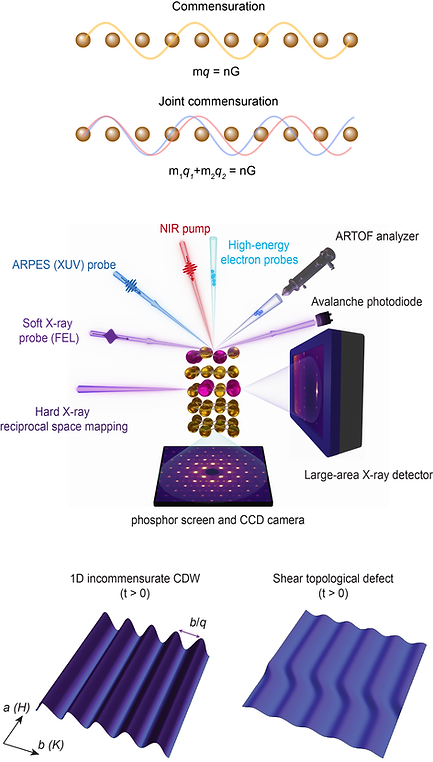
The advent of two-dimensional van der Waals moiré systems has revolutionized the exploration of phenomena arising from strong electronic correlations and nontrivial band topology. Recently, a moiré superstructure formed by two coexisting charge density wave (CDW) orders with slightly mismatched wavevectors has been realized. These incommensurate CDWs can collectively exhibit commensurability, resulting in an exotic phase known as the jointly commensurate CDW (JC-CDW). This moiré JC-CDW hosts unique emergent phenomena, such as electronic anisotropy and phase-modulated hysteresis, and holds promise for non-volatile optoelectronic memory devices. Realizing such functionalities requires a fundamental understanding of how the spatial periodicity, coherence, and amplitude of this order evolve under external perturbations.
Here, we address these questions by employing a combination of time- and momentum-resolved techniques to probe the light-induced dynamics in the moiré
JC-CDW material EuTe₄. Our combined time-resolved X-ray and electron diffraction experiments demonstrate that, under intense photoexcitation, the JC-CDW wavevector and coherence length remain locked exclusively along the CDW direction, indicative of a preserved moiré periodicity while the moiré potential depth is suppressed. This robustness governs the spatial configuration of the photoexcited JC-CDW and leads to the formation of previously unexplored shear-type topological defects. Furthermore, we developed a novel approach to simultaneously track the temporal evolution of the amplitude and phase of a CDW by tracking two diffraction peaks corresponding to one order, with findings independently corroborated by time-resolved photoemission and electron diffraction results. This combined methodology enables reconstruction of the momentum- and time-resolved evolution of the JC-CDW and direct visualization of shear-type topological defect formation. These findings not only highlight the unique robustness of JC-CDWs out of equilibrium, but also establish a new platform for optical moiré engineering through defect control.
See more details in the article: K. H. Oh*, Y. Su*, H. Ning*, B. Q. Lv., A. Zong, D. Wu, Q. Liu, G. Kang, H. Choi, H.-W. Kim, S. Ha, J. Kim, S. Sarker, J. P. C. Ruff, X. Shen, D. Luo, S. Weathersby, P. Kramer, X.Cheng, D. Choi, D. Azoury, M. Mogi, B. J. Kim, N.-L. Wang, H. Jang, N. Gedik✉️, Dynamics of a jointly commensurate moiré charge density wave, under review at Nature Communications, arXiv:2509.16493 (2025)
Sublattice-resolved phonon dynamics reveals the composite nature of a charge order


Exploiting the ubiquitous electron-phonon interaction, coherent phonon excitation not only enables selective control of phases on ultrafast timescales but also reveals phase relationships hidden in equilibrium. Charge order serves as a prime example, where
a central challenge is to determine whether purely electronic charge orders emerge independently or subordinately to their lattice–charge–coupled neighbors. Because distinct phonons modulate different sublattice orders, tracking sublattice-resolved dynamics provides a pathway to distinguish these possibilities. Yet, directly identifying real-space phonon motions with elemental specificity remains a significant challenge.
Here, we leverage time-resolved resonant X-ray scattering to measure coherent phonons with sublattice selectivity in the van der Waals material EuTe₄. Static resonant X-ray scattering unveils a purely electronic charge order in the Eu sublattice coexisting with the dominant Te charge-lattice-coupled order. Upon photoexcitation, we detect three coherent phonons associated with different sublattices by tuning the probe energy across Eu absorption edges, as corroborated by first-principles simulations.
The elemental contrast disentangles the dynamics of the Eu charge order from those
of the Te charge-lattice-coupled order, establishing that the Eu order originates independently rather than as a secondary response to Te lattice displacements. These results not only construct a broadly applicable framework for sublattice-level decomposition of coherent phonons in multi-element materials but also demonstrate
an efficient protocol for disentangling intertwined electronic phases that are difficult
to distinguish in equilibrium.
See more details in the article: K. H. Oh*, H. Ning*, Z. Shen*, Y. Su*, D. Wu, Q. Liu,
G. Kang, J. Maier, B. Ilyas, H. Choi, H.-W. Kim, S. Ha, J. Kim, B. J. Kim, N.-L. Wang, Y. Wang, H. Jang, N. Gedik✉️, Sublattice-resolved coherent phonon dynamics in charge density waves, under review at Physical Review Letters (2026).