
↘ Research highlights
Emergent phase and symmetry modulation through
collective mode excitation
*
✉️
Denotes equal contribution
Denotes corresponding author


Transient Hubbard exciton fluid
in a photodoped antiferromagnetic Mott insulator

The undoped antiferromagnetic Mott insulator naturally has one charge carrier per lattice site. When it is doped with additional carriers, they are unstable to spin-fluctuation-mediated pairing. Photo-excitation can produce charge carriers in the form of empty (holons) and doubly occupied (doublons) sites that may also exhibit charge instabilities. Antiferromagnetic correlations can enhance attractive interactions between holons and doublons, leading to bound pairs known as Hubbard excitons. However, this out-of-equilibrium phenomenon has not been experimentally detected.
Here, using ultrafast terahertz conductivity, we report the transient formation of a Hubbard exciton fluid in the antiferromagnetic Mott insulator Sr₂IrO₄. Following photo-excitation, we observe rapid spectral-weight transfer from a metallic response to an insulating response. The latter is characterized by a finite-energy peak originating from intra-excitonic transitions, whose assignment is corroborated by numerical simulations of an extended Hubbard model. The peak lifetime is short and scales exponentially with the Mott gap size, implying strong coupling to magnon modes. These results present 2D magnetic Mott insulators, which host myriad ordered and disordered phases, as a promising platform for discovering novel excitonic states.
See more details in the article: O. Mehio*, X. Li*, H. Ning*, Z. Lenarčič, Y. Han, M. Buchhold, Z. Porter, N. J. Laurita, S. D. Wilson, D. Hsieh✉️, A Hubbard exciton fluid in a photo-doped antiferromagnetic Mott insulator, Nature Physics 19, 1876 (2023).
Terahertz control of linear and nonlinear magno-phononics
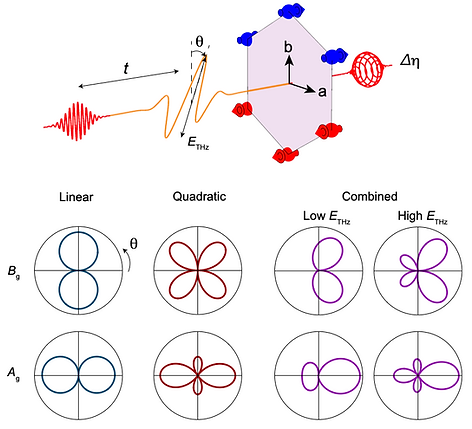
Coherent manipulation of magnetism through the lattice provides unprecedented opportunities for controlling spintronic functionalities on the ultrafast timescale. Such nonthermal control conventionally involves nonlinear excitation of Raman-active phonons which are coupled to the magnetic order. Linear excitation, in contrast, holds potential for more efficient and selective modulation of magnetic properties. However, the linear channel remains uncharted, since it is conventionally considered forbidden in inversion symmetric quantum materials.
Here, we harness strong coupling between magnons and Raman-active phonons to achieve both linear and quadratic excitation regimes of magnon-polarons, magnon-phonon hybrid quasiparticles. We demonstrate this by driving magnon-polarons with an intense terahertz pulse in the van der Waals antiferromagnet FePS₃. Such excitation behavior enables a unique way to coherently control the amplitude of magnon-polaron oscillations by tuning the terahertz field strength and its polarization. The polarimetry of the resulting coherent oscillation amplitude breaks the crystallographic C₂ symmetry due to strong interference between different excitation channels. Our findings unlock rich possibilities to manipulate material properties, including modulation of exchange interactions by phonon-Floquet engineering.
See more details in the article: T. Luo*, H. Ning*, B. Ilyas*, A. von Hoegen*, E. Viñas Boström, J. Park, J. Kim, J.-G. Park, D. M. Juraschek, A. Rubio, N. Gedik✉️, Terahertz control of linear and nonlinear magno-phononics, Nature Communications 16, 6863 (2025).
Spontaneous emergence of
phonon chirality through hybridization with magnons

Chirality, the breaking of improper rotational symmetry, is a fundamental concept spanning diverse scientific domains. In condensed matter physics, chiral phonons, representing circular atomic motions, have aroused intense interest due to their coupling to magnetic degrees of freedom, enabling potential phonon-controlled spintronics. However, selective excitation of single-handed chiral phonons has primarily required external stimuli to break time reversal symmetry and thus the degeneracy of chiral counterparts. Whether energetically nondegenerate chiral phonons can appear spontaneously remains an open question.
Here, we demonstrate that nondegenerate enantiomeric pairs can be induced by coupling to chiral magnons in the van der Waals antiferromagnet FePSe₃. We confirm the presence of magnon-phonon hybrids, dubbed magnon polarons, which exhibit inherent elliptical polarization with opposite chiralities and distinct energies. This nondegeneracy enables their coherent excitation with linearly polarized terahertz pulses. By tuning the terahertz drive polarization and measuring phase-resolved polarimetry of the resulting coherent oscillations, we determine the ellipticity and trajectory of these hybrid quasiparticles. Our findings establish a general approach to search for intrinsically nondegenerate chiral phonons and introduce a new methodology for characterizing their ellipticity, outlining a novel roadmap towards chiral-phonon-controlled spintronic functionalities.
See more details in the article: H. Ning*, T. Luo*, B. Ilyas*, E. Viñas Boström, J. Park, J. Kim, J.-G. Park, D. M. Juraschek, A. Rubio, N. Gedik✉️, Spontaneous emergence of phonon angular momentum through hybridization with magnons, under review at Nature Photonics, arxiv: 2410. 10693 (2024).
Coherent terahertz control of metastable magnetization in a van der Waals antiferromagnet

The crystal lattice governs the emergent electronic, magnetic, and optical properties of quantum materials, making structural tuning through strain, pressure, or chemical substitution a key approach for discovering and controlling novel quantum phases. Beyond static modifications, driving specific lattice modes with ultrafast stimuli offers a dynamic route for tailoring material properties out of equilibrium. However, achieving dynamic coherent control of the nonequilibrium phases via resonant excitation of lattice coherences remains unexplored. Such manipulation enables non-volatile, on-demand amplification and suppression of order parameters on femtosecond timescales, necessary for next-generation ultrafast computation.
Here, we demonstrate coherent phononic control of a newly discovered, light-induced metastable magnetization in the van der Waals antiferromagnet FePS₃. By using a sequence of terahertz (THz) pulses, we modulate the magnetization amplitude at the frequencies of phonon coherences, whose infrared-active nature and symmetries are further revealed by polarization- and field-strength-dependent measurements. Our two-dimensional THz spectroscopy, in tandem with first-principles numerical simulations, further shows that these phonons nonlinearly displace a Raman-active phonon, which induces the metastable net magnetization. These findings not only clarify the microscopic mechanism underlying the metastable state in FePS₃ but also establish vibrational coherences in solids as a powerful tool for ultrafast quantum phase control, enabling manipulation of material functionalities far from equilibrium.
See more details in the article: B. Ilyas*, T. Luo*, H. Ning*, E. Viñas Boström, A. von Hoegen, J. Park, J. Kim, J.-G. Park, A. Rubio, N. Gedik✉️, Coherent terahertz control of metastable magnetization in FePS₃, under review at Nature Physics, arxiv: 2510, 16993 (2025).